Sunday, April 5, 2015

A Kansas Wedding--Marlis and Glenn


Kids will groan when you tell a story, complaining that they've heard it a hundred times.  Then, one day, unaccountably, they'll ask you to tell it again.  Go figure.


The wedding of Marlis and Glenn was relatively low-key, perhaps in keeping with the conventions of second marriages.  Some second marriages.  One afternoon, we loaded the kids into the pink station wagon and drove over to the house of one of Marlis’s WSU friends, whose husband was a judge.  As we drove down a street of suburban Wichita houses, Marlis said “It’s one of these, I think.”

“Which one?” you might ask.  I know I did.

“I’m not sure,” she said.  “Maybe you could just knock on a few doors and ask?”

Premonitions, premonitions.

At this point, the three kids noticed that they were a block or so away from a friend’s house, and wanted to know if they could go visit.  Right then.

“Not now,” said their mother.  “Glenn and I are getting married right now.”

I thought they already knew, since they seemed to be neatly dressed for it, but maybe not.

Somehow we found the judge’s house, went in, and began a wedding ceremony that had been promised to be the equivalent of a brief courthouse civil proceeding.

Since Marlis had not long before been hospitalized in traction for her back, the first significant pause came when the judge asked for a promise of lifelong fidelity “in sickness and in health.”  She peered at me out the corners of her eyes, looking for a response, but by the time I realized what he had said, the moment had passed.

A more resounding silence came when the judge asked me for a ring to give Marlis.

“Ring?”

“Here,” said Marlis, eventually--producing her mother’s wedding ring. . .with perhaps a hint of another sideward look as her own premonitions arrived on the scene.

Yeah, definitely a sideward look.

Just when things seemed to be over and settled--and completely out of keeping with the agreed-upon Wedding Ceremony Check-List--the judge announced his wish to read aloud a relevant philosophical musing from a source purported to be Native American.  So he did, and at some length.  Really quite a bit of length.  Something about nature, ownership, sharing, earth, oneness, the stars in the sky, the prairie, treading softly in one's moccasins, clean air, responsible stewardship of the land, letting what you love go free, the Great Spirit, whatever.  You could look it up.

The moment that most lingers in one’s memory, however, came afterwards, as the judge escorted us all outside to his driveway. 

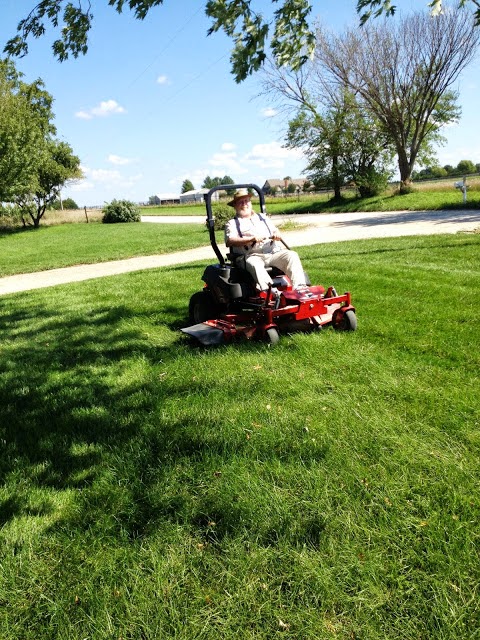
“Wait a minute, ya gotta see this” he said, opening the garage door so that we could view—and hear, and appreciate—his new riding lawnmower.


Sickness and health.  Great Spirit.  John Deere.  Your full-service wedding in Kansas.


Wednesday, April 1, 2015

Two California Weddings: Larry and Geraldine and Mary and Joe


Kids will groan when you tell a story, complaining that they've heard it a hundred times.  Then, one day, unaccountably, they'll ask you to tell it again.  Go figure.


Everybody has wedding stories.  I’d guess that no more than ten percent of them could ever be told to anyone other than a family member, and then best in a drunken stupor that would leave only a few uncertain and hopefully unactionable memories. 

But I’m especially fond of two California weddings which can safely be reported.

*     *     *     *     *     *     *

My college friend Larry and another friend’s sister, Geraldine, got married in a hippyish-era ceremony in a flower-bedecked backyard in southern California.  I remember him as wearing cowboy boots, jeans, a long-sleeved white shirt with subtle pin-stripes, a light-brown corduroy vest, a paisley string tie, and a blonde Fu Manchu beard.  That description may not be factual, but I believe it is faithful to the time and place.

Beautiful young Geraldine wore an exquisitely simple, vaguely old-timey dress.  And, yes, she wore a flower in her hair.  Simply gorgeous.

Just before the ceremony was to begin, as we stood behind the crowd, Larry confided to me in a low voice, "Wait until you hear the music I recorded for the ceremony.  It's Dylan." 

I thought it was odd that he would mention this to me at that point, but on the other hand we shared a deep interest in music.  He had shown me how to play guitar, and had also taught me a lot of old-time country songs by the likes of Jimmie Rodgers, Bill Monroe, and Reno and Smiley.  For several years, we played and sang together a lot—in living rooms, of course. 

Anyway, after Larry and Gerry had completed their home-made vows and were walking back through the seated audience, a recording of Larry singing began to play from a boom box:  "New Morning."  Very upbeat, very joyful.

A bit later, after the reception party had had a chance to settle into a groove, Larry came up to me, smiling, and said, "What did you think of the music?" 

"I'm a bit disappointed,” I said.  “I thought it might be 'Lay, Lady, Lay'." 

He laughed as if I’d made a joke.


*     *     *     *     *     *     *     *     *     *     *     *     *

The union of Mary and Joe took place in a simple churchyard atop a hill overlooking the town of Mendocino and the rocky Pacific shore beyond it. 

How can one explain Mendocino?  About a four-hour drive north of San Francisco, right on the coast among scattered redwood groves, it is a lingering slice of the Age of Aquarius, but with a much better view of the ocean.  Some residents (in earlier days) were salmon fishermen, loggers, and lumber-mill workers (mainly in nearby Fort Bragg), while the people I knew tended to pursue two or three humble part-time vocations in order to support their love of natural foods, fusion cuisine, earth-toned clothing, very, very liberal politics, Birkenstocks, and the lively arts.  It was a great place to live.

Of course, there was the time warp.  While living there in the late 1990s, Marlis and I were once invited to a costume party by a fellow faculty member at the College of the Redwoods, and I decided to go as a 1960s Berkeley hippie with black turtleneck sweater and love beads.  On the way to the bash, we stopped so I could run into a market and buy some wine.  Once inside, I realized that I looked just like everybody else in the store.

So Mary and Joe’s outdoor Mendocino wedding ceremony was held in a churchyard meadow on a gently sloping hill.  Since Mary was Catholic and Joe was Jewish, the ceremony was led by an ecumenical committee of what I felt to be alternative-lifestyle religious officers, including a rabbi (possibly), a priest (possibly), and some kind of feminist spokesperson.  As I recall, two of them were women.  You figure it out.

Quite possibly I’m making all of that up, but no matter how snotty I may sound, I’m trying to be objective.  Given my unease anywhere near a church, it wasn’t easy to focus at the time.  Anyway, Mary and Joe were warm, genuine, deeply nice people (and still are), and everything seemed plausible, unpretentious, perfect.

Down toward the lower end of the sloping churchyard was a canopy that might give shade in the unlikely event of an unfoggy day, though its main purpose seemed to be to delimit the immediate area where the bride and groom and the cheerful union trio were to do their thing.  The rest of us stood up the hill, just a bit away from the happy couple.

As the ceremony was about to begin, a gentle rain began, which then quickly increased to a downpour, and we were all invited to come down the hill and crowd close together under the canopy.  We did so, nudging shoulder to shoulder, and the ceremony began. 

After some sincere introductory remarks, one of the officiators said, "Mary and Joe believe that a marriage is not just a union of two people, but also involves all the friends and family who are an important part of their lives.  So they join in asking all of you to participate in celebrating this union.  Please recite after me." 

Some people—okay, the person “me”—might have thought, “Hey, this is a bit much.”  But then, it was Mary and Joe—Mary and Joe!—and it seemed right.  So something like the following dialogue ensued, with the officiator enunciating clearly and strongly, and the crowd murmuring gamely.

OFFICIATOR:  Joe and Mary, we all know that marriage involves the support of friends and family.

CROWD:  Joe and Mary, we all know that marriage involves the support of friends and family.

OFFICIATOR:  We promise to support your union as the days and years go by.

CROWD:  We promise to support your union as the days and years go by.

OFFICIATOR: In good times and bad, we will stand by you.

CROWD: In good times and bad, we will stand by you.

OFFICIATOR:  You are part of us, and we are part of you.

CROWD:  You are part of us, and we are part of you.

OFFICIATOR:  Well, I see the rain has let up.

CROWD: Well, I see the rain has let up.

OFFICIATOR:  No, I mean. . . .I see the rain has let up.

CROWD:  Ah.

One of the great moments in history, and I was there.  So very, very grateful.


Monday, March 23, 2015

Alice Ann


Kids will groan when you tell a story, complaining that they've heard it a hundred times.  Then, one day, unaccountably, they'll ask you to tell it again.  Go figure.

A few years ago, I got an email from a distant cousin who informed me that the town of Nephi (about 90 miles south of Salt Lake City) had an old cemetery that was nearly full, with room left for only a few family members of those already interred.  Would I like to reserve a spot?

As a kid, I had spent many wonderful times in Nephi visiting my Uncle Rulon’s family, especially my cousin Niles, since we were the same age, and also because Niles knew a million places where young boys could play in and around the dirt roads and irrigation ditches of that rural community.  Even so, I declined the opportunity to be planted there. 

But the email reminded me of an event at my parents' house in Temple City when I was back visiting home in southern California, I guess sometime in my 30s.  They had invited a bunch of family members to dinner, including my dad’s mother, Grandma Alice, and his older sister, Aunt Valate. This was after Grandma had had the misfortune to develop some kind of heart problem while visiting Los Angeles from Salt Lake City, and was deemed permanently too ill to make the trip back to Utah.  So she had moved in with my widowed aunt.  At this time, Grandma was in her 90s. 

The dinner went well, and afterwards we all sat chatting in my parents' living room.  Eventually Aunt Valate said, solicitously, "Mother, don’t you think it's about time to go home?" 

"Well, all right, Valate," my grandmother said mildly, "if you're tired." 

I managed not to laugh out loud then, but I've done so ever since, every time I've thought of it.  I'm laughing now.

The next day, while peeling spuds with my dad for another dinner, I repeated the exchange between Grandma and Aunt Valate, and said to my dad, "Gee, Grandma's got a bit of a tart tongue, doesn't she?" 

My dad replied immediately, "Well, she's a Carter."

I was struck by the fact that, after roughly 75 years of birthing and raising seven kids on an isolated ranch outside of Nephi in Utah, to say nothing of putting up with about a billion other Broadheads, somehow Grandma hadn’t yet gained full membership in the organization.  There was still that Carter asterisk.  Broadheads are a tough crowd.

A year or so later, I visited Grandma Alice at my aunt’s house in Burbank. She was nearly 96 then, and failing, so that she rarely even recognized my father when he visited her each week.  I was on my way home from northern California, and stopped off to see if I could say hello.  Luckily, she was on top of her game and in good spirits that day, and we had a nice chat for nearly an hour. 

At one point, I asked her how she made the wonderful shadow-boxes that had hung in their house in Salt Lake City, each about a foot and a half wide, maybe two feet high, and a few inches deep--and each filled with brilliantly-colored floral arrangements made out of dyed feathers.  I know that this sounds a bit like oil paintings of toreadors on black velvet, but they were very beautiful and subtle.   They ought to be in an art museum if they aren't already. 

She was just a young girl when she made them, and she was a bit daunted by the task of fetching a crucial, especially prized, highly delicate feather that had to be plucked from the posterior of a farm goose at the original Four Mile Ranch.  Apparently the goose's artistic sensibilities were not developed enough to make it fully cooperative, and it put up a heck of a battle, continually flapping its strong wings and beating young Alice Ann about the head and shoulders.  She said she heard bells ringing in her head for several days afterwards—but she got the feather.         

Of course.  She was a Carter.

I often told these stories to my daughter Emily, great-grand-daughter of Alice, and apparently she took them to heart.  When she gave birth to her second daughter, she and husband Kevin named her Savannah Carter Kuhlman.


SAVANNAH KUHLMAN
Miss Carter to you.


Sunday, March 15, 2015

Sex at the Dentist


Kids will groan when you tell a story, complaining that they've heard it a hundred times.  Then, one day, unaccountably, they'll ask you to tell it again.  Go figure.

In the 1970s, when I was living in Wichita and teaching at Wichita State University, I had a wonderful dentist.  Besides maintaining his dental practice, he appeared on local TV once a week at noon and delivered insights into the wacky world of teeth and oral hygiene.  He was also very active in the Democratic party, which I guess might have been a demerit.  My friend Georgie Cooper once claimed to be waiting in her doctor’s office and found on the coffee table a copy of the New Republic, which to her meant that he couldn’t be much of a doctor, since all doctors worth their salt were Republicans.  It was just the way things were.  So she left, she said, and found another doctor.  

I’ve always felt that she may have exaggerated this story, probably.  But—possibly not.

Anyway, I liked this dentist.  On one occasion, he went through an elaborate procedure to put fillings in two cavities on the back of my upper front teeth.  Back then, this involved stuffing my cheeks with many rods of cotton, as well as installing a rubber dam to keep the front teeth dry during the procedure.  After an hour so of work, my dentist removed the intricate dam and used mirrors to inspect his work.
 
This was in the very early days of “white fillings,” applied as goop and then hardened by a curing light. Matching the color of the goop to the color of your teeth was a coveted skill in the dental trade at that time.

He was very satisfied—enough so that he invited his dental hygienist and all of his other aides, including the receptionist, to come in and check it out, so teams of viewers were peering into my mouth.  He even set up a couple of mirrors so that I, too, could see the back of my front teeth and appreciate his handiwork.

Eventually, the crowd dispersed and he stood for a while, contented, and then asked what I thought.

Since I still had 10 or 12 rods of cotton in my mouth, I gargled out the question “Wedd gan ih tabe dis goddon aught?”  Meaning “When can I take this cotton out?”

He laughed and said, “You know, I only really forgot about that once.  A lady came in at 9:00 in the morning.  I finished with her around 10:00, and she went home.  Just before 5:00, she called and asked when she could take the cotton out.”

I half-laughed and mumbled, “Uh, and you said. . . .”

“One more hour.”

I have never really stopped laughing.  It was the perfect response, since she got a specific time to look forward to, and she didn’t have to regret having that stuff in her mouth unnecessarily for a whole day.

On another occasion, I went in to have my teeth cleaned.  This task was performed by a dental hygienist who happened to be female and also happened to be attractive.  I would say “very, very attractive,” but Someone may read this.

When she had finished scraping and flossing, she said “The doctor will be in soon to examine your teeth.  Would like a magazine to read?”

“No, thanks,” I said.

“Would you like some water?”

“I don’t think so.”

“A soda?”

“No, thanks,” I said again.  But she had sounded so much like an airline stewardess that I added, humorously, “Maybe a scotch on the rocks.”

She stood at the door, looking at me, puzzled, her head tilted slightly to one side, and said, “Scratch your rocks?”

Maybe you would have a response to that, but I had none.  If I explained what I had actually said, then she might likely realize what she had actually asked.  It was an impasse—only resolved when the dentist popped in, saw us eyeing each other silently, and said cheerily, “Hey, what’s going on in here?”


Neither of us had an explanation, so he started examining my mouth.

Tuesday, March 10, 2015

Automobiles: The Station Wagon


When I returned from Virginia to Wichita in 1981, it was merely a brief stopping point on my way to a new tenure-track job at Iowa State University, and I should probably note also that this pitstop provided an occasion for me to marry Marlis.  Since she (now we) had three tall children who hadn't yet topped out, growth-wise, we needed a new car—preferably a station wagon.  To get one, Marlis enlisted the aid of her “second father,” Frank Lies.

As a former national champion race-car driver (of super-modifieds, which at that time looked like slightly smaller versions of a 1950s Indy 500 racer), as a successful Wichita businessman, and as a very gregarious guy, Frank knew lots and lots of people, including somebody who had a fenced-in lot full of old cars for sale.  Repos?  Possibly, and one of these cars was a station wagon.  Frank thought it was a good deal, so we went to look it over with him.

It was a big old boxy, decades-old gas-guzzler.  Another Dodge?  A Chrysler?  Something like that.  Huge.  When we first saw it, Marlis and I may have gasped, or in my case may have half-whispered a very impolite but heartfelt phrase.  For the car that Frank had described as gray turned out to be pink—not actually a super-bright Mary Kay shocking pink, but a sedate grandma’s-going-to-church-this-Sunday-and-she-needs-a-car-that-will-match-her-pastel-hat pink.  Marlis said softly, “Did I tell you that Dad is color-blind?”  As middle daughter Nancy said frequently in those days, no duh. 

Unfortunately, the car was very, very cheap, and so was I, so we had to buy it.  It had lots of leg room for the lengthening kids, who would need to be able to stretch out whenever we drove down to Wichita from Ames, which turned out to be once or twice a week.  Okay, I exaggerate slightly.

When we drove the car over to Frank’s after picking it up, he motioned to me for the keys and said “Let’s go for a drive.”  At that time, Frank lived on the very edge of east Wichita, so we were quickly on a rural gravel road, at which time Frank said “Let’s blow out some carbon,” and put the pedal to the metal as I suppose he must have done hundreds of times on quarter-mile dirt tracks in his long, successful racing career.  [Frankie Lies.  Yeah, that guy.]  

A huge black cloud immediately billowed up behind the car.  “That carbon can really build up in these older cars,” Frank said, perhaps as a philosophical musing, or more likely as a terse explanation for non-racing simpleton college professors.  By that time, I could see out the corner of my eye that we were going somewhere between 90 and 100 miles an hour on this crappy gravel road, and I think that’s when my panicky right hand formed a lasting impression in the right-side door panel where it meets the window.  In later years, I would occasionally wake up screaming in the middle of the night, but I can truthfully say that we never, ever, ever had a problem with carbon build-up.

Driving a big old boxy, decades-old, pink gas-guzzler station wagon around any town does not earn you many bachelor-of-the-year awards, so I definitely knew I was married.

When we got to Ames, we found that there was still a functioning Welcome Wagon in that sleepy college town.  Among the goodies in the Welcome Wagon Gift Basket was a certificate for a free haircut.  Marlis thought that it would be good for me to get a trim before showing up for my first day of work at Iowa State, so I drove the pink beast into downtown Ames and parked in front of the free haircut venue, which turned out to be a beauty salon called Madge’s of San Francisco.  I kept telling myself, “You’re a 38-year-old married man on a strict budget.  You can do this!” So I got out of Pinky and casually strolled into Madge’s of San Francisco, free-haircut certificate in hand.

I may have felt more compromised in my lifetime, but I couldn’t tell you when.

The pink beast rendered useful service for a couple of more years, but eventually was replaced as the family car by a new minivan.  Even so, we got yet more mileage out of it because the eldest, Linda, drove it to high school throughout her senior year.  Or perhaps I should say “drove it near her high school.”  Many, many years later, Linda remarked with something approaching sarcasm that she was so embarrassed by the car, she would park it a couple of blocks from the school and walk the rest of the way.

 I’ve never fully understood her fussiness.  I mean, geez, the wipers worked fine.

I've certainly had a few more cars since Pinky, but they were just cars.  No drama, no fun, simply transportation.

Saturday, March 7, 2015

Automobiles: The Pickup (Continued)


I didn't know that, if you buy a pickup, your weekends and several midweek days end up helping friends tote things around—big, heavy things like household appliances and pianos.  Okay, some Wichita friends used my pickup to move a piano for me when I was out of town.  But the point is still valid.

One day, my Wichita State colleague and good friend Jim Berlin told me that he wanted to make a sandbox in his back yard for his two boys, using a huge old airplane tire as a frame.  Jim asked if we could take my truck and go get some sand to fill up the tire.  “Sure,” I said.

I drove my half-ton pick-up to the sand place, kind of half-remembering that, the week before, a mechanic had told me that the pickup’s dicey clutch might last several more months, but that I should be careful with it.  So I carefully inched the truck into the tunnel under the three-story structure that held the gigantic chute that dispensed the sand.  The operator yelled “How much?” and Jim leaned out the right-side window and said “Let’s try a ton.”  With an electrifying rushing sound and then a deafening BLAM, the sand smashed into the bed of the pickup, which creaked and settled uneasily under the load.  “How‘s that?” asked the operator, and Jim, who was nothing if not expansive and good-hearted, said enthusiastically, “Let’s try another ton.”  Whoosh BLAM.  As I pulled slowly, ever so slowly out from under the sand chute, I could pretty much spin the steering wheel without altering the direction of the pickup, whose front wheels seemed only occasionally to drop down and touch the earth.

After a long, slow, agonizing trip, we got to Jim’s backyard and filled up the old airplane tire.  This used up at most a tenth of the sand in the truck bed.  So we started calling every young couple we knew, asking them if they wanted to build a sandbox for their kids.  Really, actually insisting that they build a sandbox for their kids.  We spent the rest of the day driving around Wichita and shoveling out sand, but at the end of the day, I still had about a ton of the stuff in the back of my truck.

Not surprisingly, I guess, this didn't really trouble me all that much.  The sand stayed there for well over a year, providing very good traction in winter.  No more fishtails for me, no sir.

One afternoon, while engaged in a philosophical discussion in Kirby’s bar across the street from Wichita State, I asked Jim Kirby, “Hey, why do they call my truck a half-ton?”  As an experienced bartender, Kirby had only a trace of a smile on his face.  “Well,” he explained at last, “that means it’s able to carry a half-ton load.”  Ah. 

As usual, this opinion prompted a lively discussion among that afternoon’s bar patrons, who varied greatly in cultural and educational backgrounds, to say nothing of sobriety.  Since the tavern’s denizens were notoriously given to making wagers (wagers, not wages), Kirby spoke for all in saying “Glenn, you’re never going to get rid of that sand.”

This stung a bit, and I replied, “Jim, I’ll bet you a beer that I’m going to sell it to the next guy who walks in the door.”  There was a general clamor as multiple side-bets were negotiated, and then everyone turned to stare expectantly at the door.

Pretty soon, actually, a guy walked in who had never been in the bar before.  He hadn't taken more than two or three steps when I said “How would you like to buy a ton of sand for $10.”  He said, “That’s incredible.  I just started putting in a patio.  I’d love to have some sand.”  So we delivered it right then.  When I got back to the bar an hour or so later, it was if I had just inherited the Coors brewery.  Complete amazement, hearty if bewildered congratulations, and of course one free beer.

Later, I drove this truck to the east coast when I got a job at Hampden-Sydney College, located about ten miles from Farmville in south-central Virginia.  Unfortunately, by then the pickup also had starter problems, so as I traveled east I could only stay at motels located on a hill, in order to be able coast down and get the engine going in the morning.  When I got to Farmville, I didn't stop and park, but immediately drove around town until I found a garage.  I pulled in and explained to the owner/mechanic about the truck not starting.  He said he wouldn't be able to get to it for a week.  I told him that I had just gotten into town for a job at Hampden-Sydney College (several miles from Farmville), and that I needed the truck to get to work. 

This gray-haired mechanic, clad in oil-stained bib overalls, and with his greasy hands on his hips, looked at me with steely eyes.  I immediately remembered the advice of my friend Georgie Cooper, born and raised in the Mississippi Delta, who told me just before I left for Virginia, "Ga-lenn-uh, if some old redneck tells you to 'mind yer own bidness,' you mind it!"

“You’re a teacher at Hampden-Sydney College?” he eventually asked in his Virginia drawl.

“Yes,” I said, “Just starting this semester.  I haven’t even found a place to stay yet.”

“What do you teach?”

“English.”

“Oh, Jesus,” he said.

“Is there something wrong?” I asked, a bit defensive, but trying to mind my own bidness.

“Oh, it’s not that,” he sighed.  “My son just got a masters degree in English.”

There was a significant pause.

“Look,” he said finally, “I know you don’t have any money.  I’ll tell you what—I’ll work on it this afternoon, and I’ll only charge you for parts.”


I always knew I had picked the right major.

. . . . . . . . . . . . . . . . . . . . . . . . . . . . . . . . . . . . . . . . . . . . . . . . . . . . . . .


Much later, I received the following gift from Linda, Nancy, and Steve:


Sunday, March 1, 2015

Automobiles: The Pickup [With Intrusion by MMB]


Kids will groan when you tell a story, complaining that they've heard it a hundred times.  Then, one day, unaccountably, they'll ask you to tell it again. Wives will insist they can tell it better.

The Pickup
When the VW died in a wreck, I bought a used 1959 pickup truck.  A Chevy, I think, but possibly a Ford.  I know it was light green.

I eventually took this vehicle to Wichita in late 1972, where every winter it would fishtail a few times on icy streets.  Usually a curb would stop the spin. 

One summer night, for some reason, I mindlessly locked it up when it was parked on the street.  Naturally, somebody broke the right-side window in order to steal, um, nothing, of course.  Or maybe a fledgling thief broke in just for the practice.  In any case, even after I had a new window put in, the vehicle still wasn’t exactly cherry. 

In fact, this truck became increasingly run down, and at one point the windshield wipers stopped functioning correctly.  That is, they would have enough poop to sweep up to the left, but not enough to go back down to the right.   I didn’t learn this in shop at AHS, but I tied a heavy cord to the right-side wiper arm and ran the cord through the right wing-window into the cab of truck, with enough cord in the interior to reach over to the driver.  Thus, when it rained, I could turn on the wipers, and when they got stuck (i.e., every time they went up to the left), I could tug on the cord so that they would return to their “down” position.  Eventually, I improved on this design when I found that, if I shut the right wing-window on the cord with just the right amount of tension, the cord would work like a bungee, and the wipers would return to their “down” position with virtually no effort by me.

One day, however, after I had parked the car to the side of the driveway of the house I was renting, I found when I returned to it that it wouldn’t start.  As it happened—wait a minute, the wife insists on hijacking this narrative.


Both my fathers were race car drivers, so I grew up watching and listening to super mechanics who knew how to make ordinary cars into faster cars, winning cars, treasured and legendary cars.  (My first car was a '55 Chevy that could do 105 in a quarter.)

Sometime in the late 70s, when my first father was visiting, I asked him to take a look at the Ford truck that my professor-boyfriend had left parked beside his house’s driveway because, he said, it wouldn't start and he didn't know what was wrong.   Professor Broadhead happened to be out of town that weekend, so this was to be a surprise for him.  (Yes, I got all As; now please try to focus on the story.)  Dad agreed to take a look.

It was an old, faded green truck, tired and scruffy—all  the more so as I now viewed it through my father's eyes, who at that time had a pristine red Dino Ferrari tucked into his garage back in Bellevue, Washington.

The first task, of course, was to raise the hood and check for possible problems.  The old engines were slight compared to the tightly-packed conglomerations of metal you find under hoods today.  Back then, you could sit on a fender with your feet propped inside to work on one.

As we peered into the engine compartment, Dad gave me a WTF look but said only, "The battery."   I looked.  It had tumbled from its rusty perch and collapsed onto a hose beneath it, where it dangled by a single cable.

Dad used his handkerchief to lift the battery back onto its little platform and reattach the other cable while I went into the house to look for something to secure it with.

All I could find was a pack of multi-colored pipe cleaners, so I twisted them together and strapped the battery back in place while Dad worked on straightening out the hose.

We discussed trying to start the car, but in the end it seemed best to leave well enough alone. 

Sidebar:  Later, that vehicle was to become known as "the truck I gave up for the woman I love" when he sold it to buy a station wagon that would hold a new wife and three tall step-children.  That car is a whole other story.

                                                               Marlis Manley Broadhead


Remember, she has an MFA in fiction.

However you tell it, this incident apparently gave Frank no very positive opinion of my mechanical skills or general mental capabilities.  I’m not sure about Marlis.  But her pipe-cleaner remedy proved to be equally as effective as my windshield wiper cord, proving that women can be just as good with mechanical objects as men.


More about the pickup soon.

Thursday, February 26, 2015

Automobiles: The MG and the Dodge


Kids will groan when you tell a story, complaining that they've heard it a hundred times.  Then, one day, unaccountably, they'll ask you to tell it again.  Go figure.


The MG

After working at a gas station through the summer of 1959, I had earned enough money for a tonier car—a  1951 MG-TD, an elegant model whose styling was halfway between the super-boxy MG-TC and the sleeker, more modern MG-A.  It was maroon, and since it was a version called the Mark II, it had chrome headlights and additional trim.  It was the first car I ever bought with my own money, and it cost $500.  Being 17 years old, I naturally spent $600 to have black-leather seat upholstery installed.  The car looked great. 

Unfortunately, oil regularly fouled the sparkplugs—at least once a week—but I was then working part-time at a gas station and could easily clean them myself to keep the car running.  Other than that, the car had various kinds of mechanical breakdown about once every few months. Maybe weeks.

When I took it in to the European Motors garage to be worked on for the umpteenth time, the owner/mechanic asked me if I wanted to buy an Austin Healy.  I said I loved those cars, but I already had an MG.  He said, “Yeah, but if you bought the Austin Healy, you'd have something to drive when the MG is in for repairs.”  

When your mechanic makes that kind of joke, you know you’re in trouble.  He made a small fortune off of me.

I liked to drive around with the top down, smoking a Crooks cigar, and making an ultra-cool wave to other MGs on the road (lifting up the first finger of the right hand while continuing to grasp the wheel with the other fingers).  This gesture was every bit as necessary as my buckled-back driving cap.

I sold the MG when I moved north in 1963 to start graduate school at San Francisco State.   My father  had convinced me that it rained too much up there for a convertible (not so), but what carried the day was learning what a 21-year-old male would have to pay to insure a sports car in the Bay Area.

So I sold the MG for $1,000, thus losing only about two or three thousand on the deal.


The Dodge Sedan

I replaced the MG with a 1955 Dodge sedan that John and Georgie Cooper kindly sold to me for $50 since they knew I was getting rid of my MG.  This was not only the cheapest car I ever bought, but also the most economical, in that I never had any repairs or maintenance costs (other than adding a quart of oil every now and then) during the eight or so years that I owned it.  It was a stick shift, but had some kind of magical second gear so that, if you were stopped while going up a hill in San Francisco, you could easily let out the clutch in second and keep going uphill without having to shift (and thus risk stalling the engine and rolling backwards down the hill).  You could also go quite fast in second gear, so in that respect it was my first automatic shift car.

This doughty auto performed admirably well into my graduate school years at UC-Davis (near Sacramento), where I lived on a tree-lined road that also served as an off-ramp for the freeway.  The house had previously been rented to my pal Michael Burns, and he convinced the owner, Mr. Callori, that I was a responsible adult.  Mr. Callori soon learned that I was not, but he was infinitely patient.  For example, I rarely mowed the lawn, which could (and did) grow several inches high—much higher, if you counted the weeds—but Mr. Callori put up with this eye-sore behavior even though I lived next door to his immaculate house and yard.  Fronting the property alongside the road was a space to park cars, then a row of huge shade trees, and between them and the lawn, a hedge of tall shrubs about 6 or 7 feet tall (since I never trimmed them). 

One day, as I was driving home and pulled in to park under the trees, the brakes failed and the car passed between two trees and crashed through the hedge.  Luckily, the tall grass of the unmown lawn slowed the car, which came to rest about a foot away from the house.  A few beers induced some husky friends to help me push the car back through the hedge, and the Dodge was soon replaced by a VW square-back sedan.  Even so, the Dodge rested contentedly under the trees for several months. 

As it happened, each day when I walked to school I passed a small mom-and-pop market a few hundred feet to the south of my yard.  One day, on the way home, I stopped in to buy some beer.  The pop of the ownership said to me, “Hey, what are you going to do with that Dodge?” 

“I hadn’t thought about it,” I said truthfully, although my father would have approved of this as a bargaining gambit. 

“Well,” he said, “what would you take for it?” 

“Two six-packs,” I said.  “Talls.”  This added consideration was a bargaining ploy that my Dad may or may not have approved of, since beer was involved.  In any case, the deal was closed. 

Later that day, more beer and a new shift of husky friends helped me push the car down to the grocery-owner’s yard, which was next to the market.  It was a pleasant little house with a white picket fence running around the neatly mown lawn in the front yard.   Between the fence and the roadway, there was room for cars to park under tall shade trees, and that's where we left the Dodge. Under those trees, the grocery owner started working to repair the brakes, which took him several days. 

As it happened, I was walking home from school one afternoon just as he finished the job.  He gave me a friendly wave as he got in the car to give it a whirl.  He backed the car into the street, but the car didn’t stop, and he desperately made a high-speed U-turn, going backwards straight through his white picket fence.  I tried really hard not to laugh, but was deeply struck by the symmetry of our experiences.  He only swore a little bit, and then vowed to finish the job.  He and I pushed the car back under the trees, where it remained for a week or more as he toiled away on it. 

Eventually, as I was walking home late one afternoon, I saw that the car was gone, so I went into the grocery store to see what was up. 

“Where’s the car?” I said. 

“Well, uh….I sold it,” he said. 

“So you got the brakes working,” I said. 

“Well, uh, yeah.  They worked.” 

“How many times did you test them?” I asked. 

“Well, uh … I only tried them once and then this guy came and bought it.” 

“Ah,” I said. 

“Actually,” he said, “I feel kind of bad about it."

"Why?" I asked.

"The guy lives in Nevada.” 

A deep silence pervaded the grocery store as we both somberly envisioned this guy driving the car home over the Donner Pass of the High Sierra.  For the next several days, I scoured the Chronicle and the Bee for news of a motorist in a black 1955 Dodge sedan plunging to his death on the sharp downgrade to Reno.  I bet the grocery-store guy did, too.  Such an article never appeared, but I took little or no solace in this.  An article may have appeared in the Reno newspaper.


I thoroughly enjoyed the beer.  Best car deal I ever made.

Tuesday, February 24, 2015

Automobiles: The 1951 Ford


Kids will groan when you tell a story, complaining that they've heard it a hundred times.  Then, one day, unaccountably, they'll ask you to tell it again.  So it goes.


AUTOMOBILES
I once casually asked my wife’s father how many cars he had owned.  I think the number at that time was 52, and he proceeded to fill me in on the details of each vehicle over the next several hours.  My own list is shorter.

The 1951 Ford
I got my first car as a sixteenth birthday gift from my parents in 1958, toward the end of my junior year in high school.  My father took me out to shop for a vehicle, and we hit many low-rent used car lots around Temple City, where we lived.  Shopping with my father was no picnic, as he believed that every salesman was a low-life bastard trying to screw him, so his demeanor ranged from stony silence to terse, caustic remarks to the sales-force felon.  At the time, this embarrassed me, as I didn’t yet understand that my father was right.  After several high-tension encounters at various car lots, my father settled on a tan 1951 Ford sedan, at a cost of $150, and asked me if I wanted it.  By then, I would have accepted a pogo stick if it meant I didn’t have to go to another lot with my father, so I said yes, and we bought it.  $150 was a low price even in 1958, but the car had previously been owned by a mailman, who had racked up over 200,000 miles with it.  Also, the trunk lid had been damaged and couldn’t be opened, so on the way home with the car, we stopped at a junkyard, where my dad purchased a somewhat rusty, chalky, powder-blue replacement that he installed when we got home.  So it was an unconventionally two-toned car.  But it was wheels, and it was mine.

Another problem, it turned out, was that the front seat had been worn out during its years in the postal service, so that the seat rolled backward or forward as the car accelerated or decelerated.  Since my father’s trunk replacement had slightly unnerved me, I fixed this problem myself by jamming a wooden coat-hanger into the seat mechanism.  Worked fine.

The next day, I drove my new car to Arcadia High School (we were in the Temple City mailing district, but the Arcadia school district).  As the day wore on, I offered rides home to just about everyone I knew.  Um, every girl I knew.  Five accepted the offer, and I felt like a teen prince as I slowly inched my carload of chicks out of the school parking lot.  I drove up Santa Anita Boulevard and stopped for a red light at the four-lane Colorado Boulevard.  When the light changed, I pulled into the intersection, but botched the stick-shift move into second and stalled the car.  Other motorists were immediately irked by the delay I was causing and honked at me mercilessly, and a couple of the girls rather stridently urged me to get going.  I finally forced the clutch into first gear and stomped the gas pedal to the floor.  Unfortunately, the weight of the two girls and me forced the front seat backward, breaking the wooden coat-hanger, so that, while the car started inching slowly through the intersection, I was unable to reach any of the foot controls, and could barely get my hands on the steering wheel.  After too many agonizing moments, I got the girls to coordinate in scrunching the front seat forward, so that my desperate feet could once again reach the pedals.

The rest of the trip is still a blur, but couldn’t have been much fun, since a couple of the girls lived in the hilly area toward the north end of Arcadia.

Later, drawing upon valuable lessons learned in shop class during my freshman year, I found a new and permanent solution to the seat problem by using a wire coat-hanger.

Though the seat issue was resolved, other matters occasionally arose to bite me or my passengers in the butt.  One summer day, when my life-long friend Bob was riding shotgun, we stopped at a Foster Freeze for a couple of tall cones.  As we pulled out of the lot, Bob was holding both of them so I could devote my attention to a left turn through a busy intersection.  Midway through the turn, the right door suddenly flew open and Bob tumbled out.  He rolled once, but somehow kept the cones upright as he came to his feet.   Both he and the Frosties were unscathed.  Or at least the cones were.  He may have had complaints that he never complained about to me.  He was always a good athlete, but in this case, I think it may have been family frugality that was most at play.  In those days, those cones must have been 15 cents apiece, at least.

I wonder if I ever had that door repaired.  I can’t see how a coat-hanger would have helped much.  Probably I just warned people not to lean on the door.